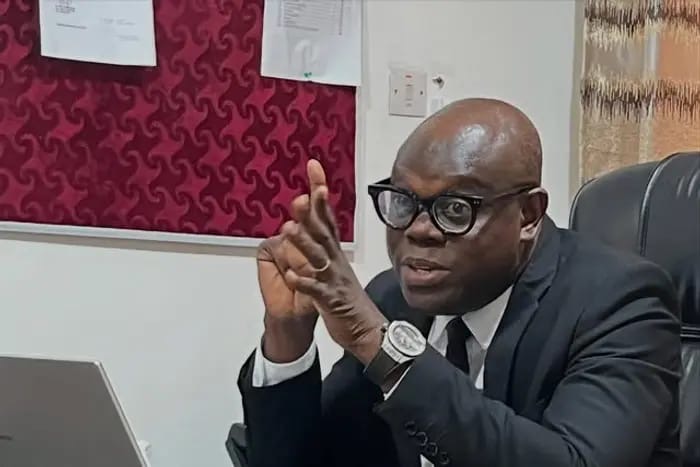
The Executive Secretary of the Bureau of Ghana Languages (BGL), Ebenezer Ahiator, has come under intense public criticism after categorically rejecting calls for Ghana to adopt one of its indigenous languages as a national language.
Mr. Ahiator’s position, presented before Parliament’s Committee on Chieftaincy, Culture and Religious Affairs, has triggered a fresh and heated debate over Ghana’s continued reliance on English and what critics describe as the relegation of indigenous languages in the affairs of the state.
Ghana has a rich linguistic heritage, with over 80 languages including Akan/Twi, Ewe, Ga, Dagbani, Dagaare, and Gonja spoken across the country.
Yet English remains the official language and dominates formal government business, education, legislation and administration. For Mr. Ahiator, that arrangement should remain unchanged.
Mr. Ahiator told the parliamentary committee that Ghana should not select one indigenous language as the country’s sole national language because doing so could create the impression that speakers of other Ghanaian languages are inferior or have been relegated to second-class status.
“English is there for all of us. English is supposed to be spoken by everybody, but your language is your language,” he told the committee.
He argued that Ghana’s linguistic diversity is a national asset and that unity does not mean uniformity.
Elevating a widely spoken language such as Twi, he warned, could marginalize speakers of other indigenous languages.
But sections of the Ghanaian public are asking a blunt question: Why should English remain above Ghana’s indigenous languages simply because Ghanaians speak different local languages?
Critics, including proponents of an indigenous national language, have accused the BGL boss and the Minister for Tourism, Culture and Creative Arts, Abla Dzifa Gomashie, of making what they describe as absolutist statements that seek to shut down a debate that should belong to the Ghanaian people.
According to them, neither linguistic diversity nor the fear of ethnic tensions should be used to permanently rule out the possibility of Ghana adopting an indigenous national language.
They argue that the issue deserves a comprehensive national debate involving linguists, traditional authorities, educators, political leaders, and ordinary citizens.
One of the major arguments advanced against the adoption of an indigenous national language is that it could eventually destroy Ghana’s other local languages.
But critics point to countries such as Ethiopia, where Amharic occupies a national role while several other indigenous languages remain vibrant and widely spoken.
They also argue that Ghana would not necessarily have to abandon English. An indigenous national language could coexist with English as a co-official language, just as Swahili and English operate alongside each other in Kenya.
The strongest push has come from advocates of Akan, particularly Twi, which is among the most widely spoken indigenous languages in Ghana.
They argue that if Ghana is serious about developing a national language, demographic realities must form part of the conversation.
However, this position has also drawn resistance. The Fante Patriots Alliance recently condemned the government’s decision to exclude Fante from an AI language integration project, arguing that “Twi does not represent us” despite both languages falling under the Akan family. Similarly, the GaDangme Council has raised concerns over the exclusion of Ga from such initiatives, warning it could deepen marginalization.
Critics are demanding political courage to confront what they describe as a language problem that successive governments have avoided.
They argue that Ghana’s future generations should not inherit a system where an inherited colonial language remains the principal language of official national life while indigenous languages struggle for institutional recognition.
Some have even suggested a referendum to allow Ghanaians themselves to decide whether the country should adopt an indigenous national language and, if so, which one.
Critics are also calling for a rethink of where the Bureau of Ghana Languages is positioned within the government.
They argue that the BGL could be moved from the Ministry of Tourism, Culture and Creative Arts to the Ministry of Education, where its mandate could be more closely linked to language teaching, curriculum development, literacy and the preservation of indigenous languages.

Ghanaians condemn BGL boss’ rejection of indigenous national language added by Editor on
View all posts by Editor →